
You are here
Afrique
Burkina : Le SIPEN-UEMOA offre du matériel informatique à l'agence Faso Mêbo en soutien à ses opérations
À la veille de l'ouverture du Salon international des professionnels de l'économie numérique de l'UEMOA (SIPEN-UEMOA), les organisateurs ont remis, ce lundi 13 juillet 2026, un important lot de matériel informatique à l'agence Faso Mêbo. Ce geste, qualifié d'acte patriotique, vise à renforcer les capacités opérationnelles de la structure tout en illustrant l'engagement des acteurs du numérique en faveur du développement du Burkina Faso.
Les organisateurs de la quatrième édition du Salon international des professionnels de l'économie numérique de l'UEMOA (SIPEN-UEMOA) ont procédé à la remise d'un lot de matériel informatique à l'Agence Faso Mêbo. Ce don intervient à la veille de l'ouverture officielle du salon, prévue les 14 et 15 juillet à l'hôtel Silmandé autour du thème : « Refonder l'économie numérique au sein de l'UEMOA : intelligence artificielle, fintech et finance inclusive. »
Le président du comité d'organisation du SIPEN-UEMOA 2026, Évariste Tassembédo, remettant symboliquement le don de matériel informatique à l'agence Faso Mêbo.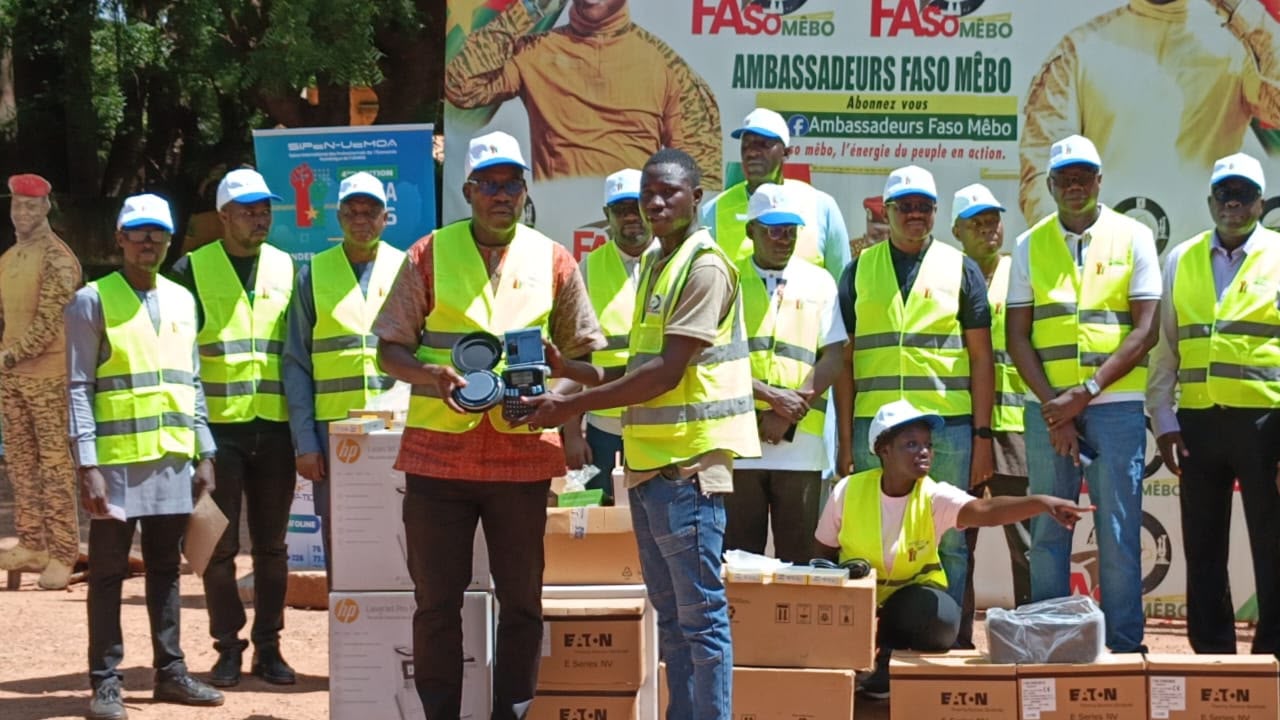
Selon le président de la Fédération des acteurs du numérique du Burkina Faso (FED Numérique) et président du comité d'organisation du SIPEN-UEMOA 2026, Évariste Tassembédo, cette initiative traduit l'engagement des acteurs du numérique des huit pays de l'UEMOA à accompagner les efforts de développement du Burkina Faso.
« Ce don s'inscrit dans un acte patriotique. Avec l'ensemble des délégations présentes au Burkina Faso, notamment celles des sept autres pays de l'UEMOA, nous avons décidé d'offrir ce matériel informatique afin de témoigner notre soutien aux initiatives de développement engagées par les autorités », a-t-il déclaré.
Le président du comité d'organisation du SIPEN-UEMOA 2026 a réaffirmé l'engagement des professionnels du numérique à accompagner les initiatives nationales de développement.
Le matériel remis est composé d'imprimantes multifonctions, d'onduleurs, d'un système de gestion du temps de présence, d'un dispositif de visioconférence ainsi que de kits de communication (oreillettes et dispositifs mains libres). Ces équipements permettront d'améliorer les conditions de travail des équipes de l'Agence Faso Mêbo, de renforcer le suivi des activités, la gestion des ressources humaines, la communication interne ainsi que la production de statistiques fiables.
Le matériel remis comprend notamment des imprimantes multifonctions, des onduleurs, un système de visioconférence, un dispositif de gestion du temps et des kits de communication.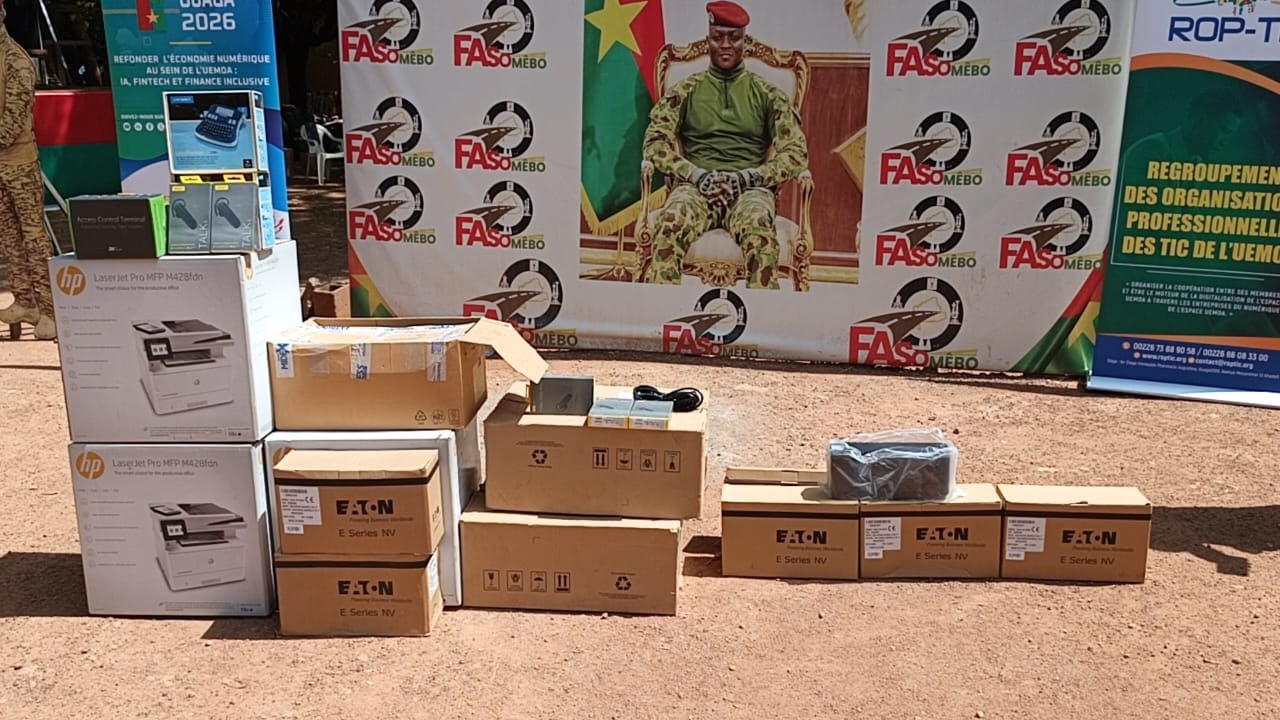
Pour Évariste Tassembedo, le choix d'offrir du matériel informatique répond à la volonté d'accompagner l'agence dans la modernisation de ses méthodes de travail, en complément des appuis déjà apportés à travers d'autres initiatives nationales.
Le SIPEN-UEMOA est le Salon international des professionnels de l'économie numérique de l'UEMOA. Organisée cette année à Ouagadougou, cette quatrième édition est coorganisée par le ROP-TIC et la FED Numérique, avec l'appui du ministère de la Transition digitale, des postes et des communications électroniques, de la Commission de l'UEMOA, du BOAD, du COGEF et de l'ARCEP.
Les responsables du SIPEN-UEMOA ont travaillé aux côtés des équipes de Faso Mêbo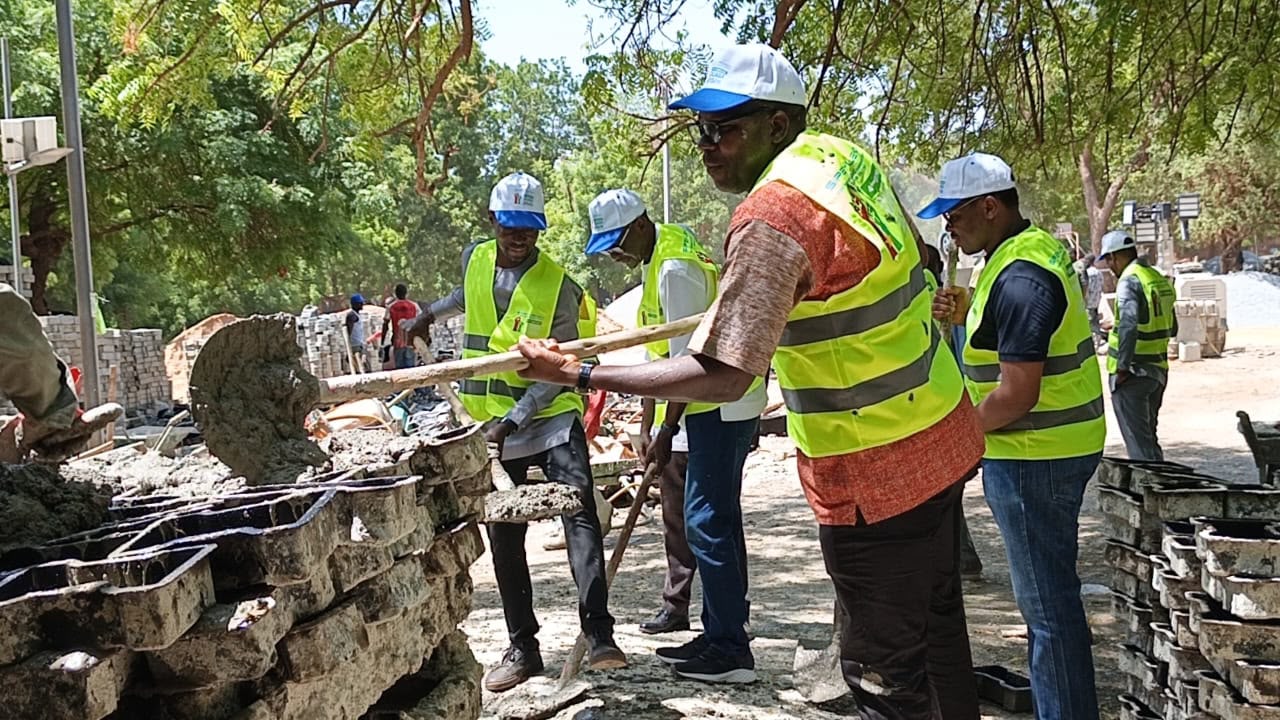
Le salon réunira des décideurs publics, des experts, des entreprises et des partenaires techniques autour des enjeux du numérique. Plus de quarante exposants présenteront leurs innovations, tandis que plusieurs panels porteront notamment sur l'intelligence artificielle, la finance inclusive, la gouvernance numérique et les politiques publiques en matière de transformation digitale.
À travers ce geste, les acteurs du numérique de l'UEMOA réaffirment leur engagement en faveur du développement et de la modernisation des services publics au Burkina Faso.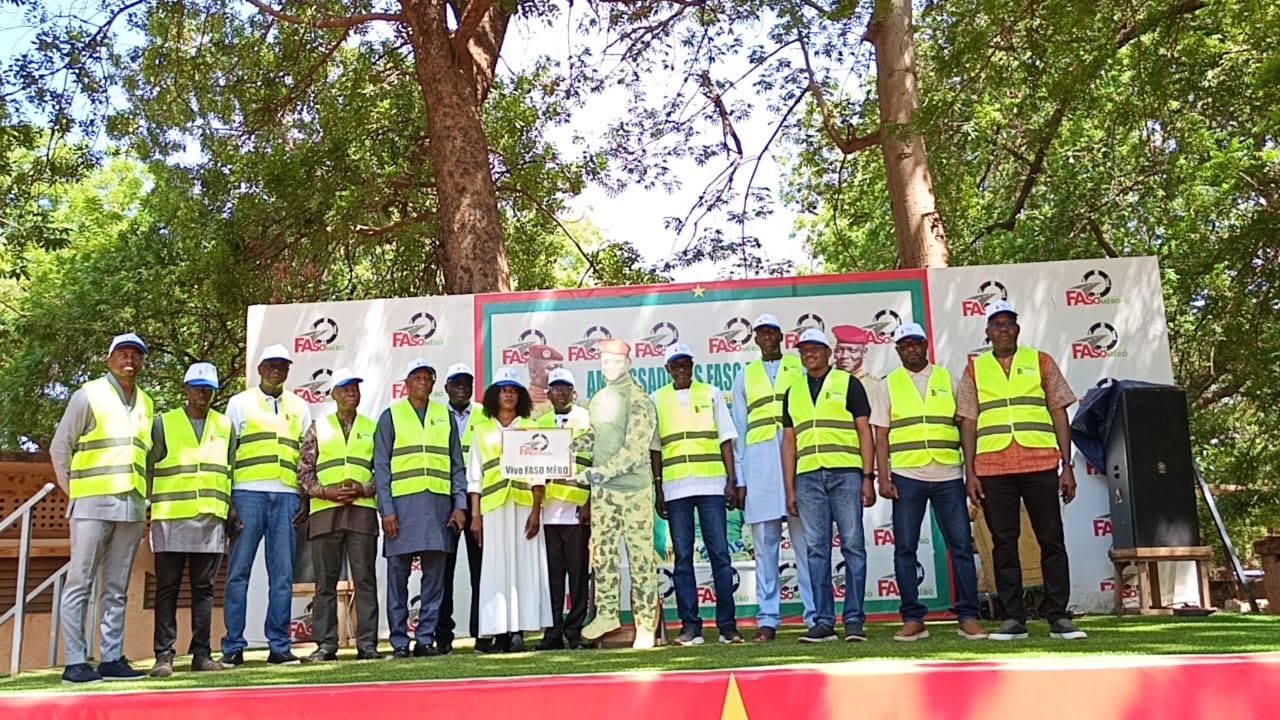
À travers ce don à l'agence Faso Mêbo, les organisateurs entendent démontrer que le numérique constitue un levier concret au service de la modernisation de l'administration et du développement socio-économique.
Anita Mireille Zongo
Lefaso.net
Categories: Afrique
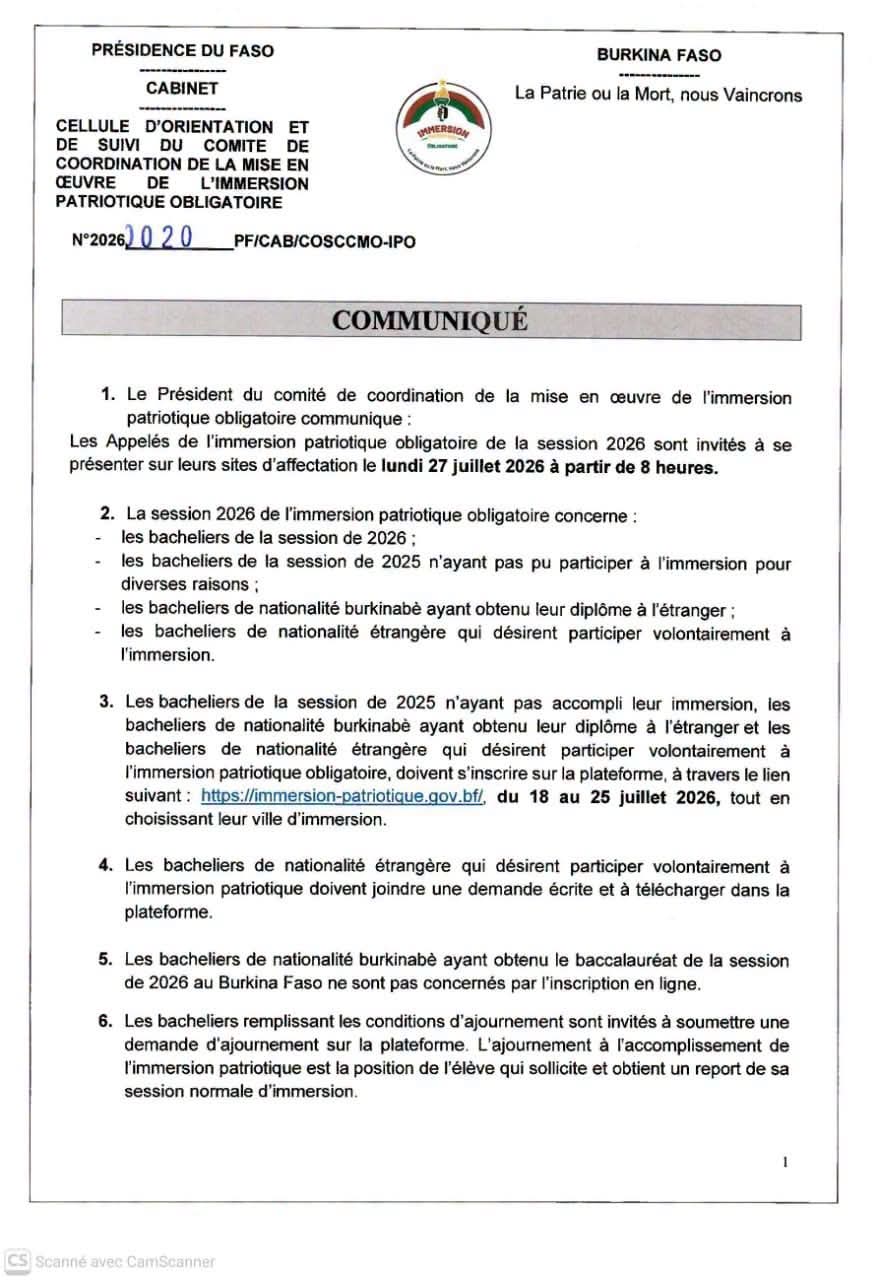
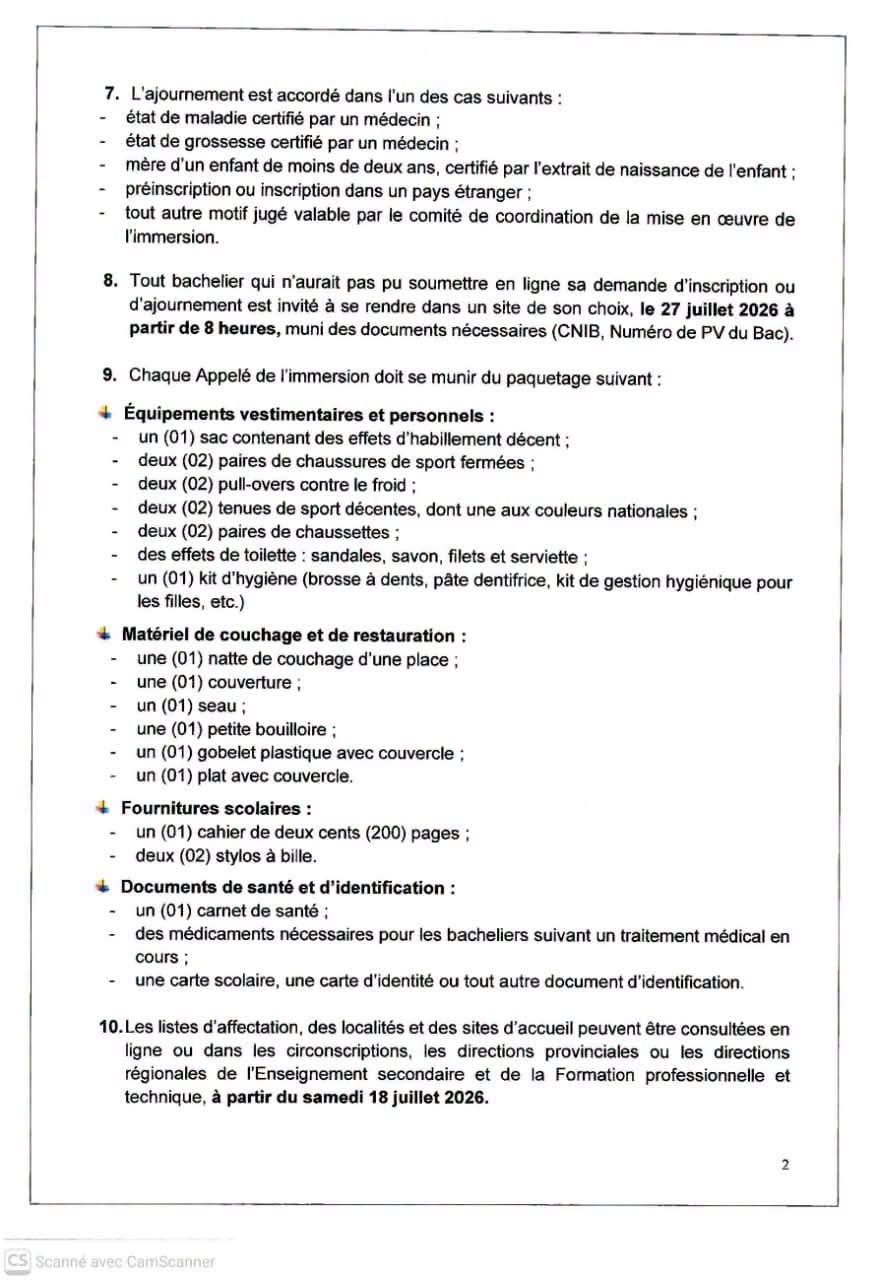
Burkina : Les appelés à l'immersion patriotique obligatoire convoqués sur leur site d'affectation le 27 juillet 2026 à 8h
Dans le communiqué ci-après, la cellule d'orientation et de suivi du comité de coordination de la mise en oeuvre de l'immersion patriotique obligatoire, informe les bacheliers 2026 qu'ils sont tenus de se présenter sur leur site d'affectation le lundi 27 juillet 2026, à 8h. Le communiqué précise par ailleurs, les conditions à remplir pour les bacheliers 2025 n'ayant pas accompli l'immersion, ceux de nationalité étrangère entre autres.
Lisez plutôt !
Lefaso.net
Categories: Afrique
Burkina/Frais de scolarité dans le privé : Le gouvernement fixe de nouveaux critères de réglementation
Le ministère de l'Enseignement de base, de l'alphabétisation et de la promotion des langues nationales a adopté un arrêté portant réglementation des frais de scolarité dans les structures privées d'éducation préscolaire et d'enseignement primaire. Ce texte, pris en application du décret du 3 juillet 2026 sur les frais de scolarité dans l'enseignement privé, définit les composantes des frais exigibles ainsi que les critères qui encadreront leur fixation.
Selon l'arrêté, les frais de scolarité comprennent les frais d'inscription, la carte scolaire, l'inscription à la bibliothèque et la contribution en rame de papier.
Leur montant sera déterminé en fonction de trois principaux critères que sont la zone d'implantation de l'établissement, le niveau d'investissement réalisé en infrastructures et équipements, ainsi que la qualité de l'offre éducative.
Les autorités prennent notamment en compte les conditions d'accueil, les équipements disponibles, la qualification des enseignants, les résultats scolaires, les effectifs par classe et l'enseignement de disciplines telles que les TIC, l'anglais ou les langues nationales.
Cette réglementation vise à harmoniser les pratiques tarifaires des établissements privés tout en encourageant l'amélioration de la qualité de l'enseignement.
Plus de détails dans l'arrêté ci-dessous.
Lefaso.net
Source : Ministère en charge de l'Enseignement de base
Categories: Afrique
Mondial 2026 : la fédération sénégalaise explique les raisons du départ de Pape Thiaw
Au Sénégal, c'est l'heure des comptes après l'élimination controversée des Lions de la Teranga à la Coupe du monde 2026. La Fédération sénégalaise de football, qui s'est séparée du sélectionneur national Pape Thiaw pour des raisons sportives s'est expliquée ce lundi face à la presse.
Categories: Afrique
Mengistu, le « Négus rouge » éthiopien, fantôme d’Harare
« Chefs d’Etat africains en exil » (2/6). Autrefois colonel tout-puissant de la junte militaire éthiopienne, l’ancien despote Mengistu Hailé Mariam, aujourd’hui âgé de 89 ans, se terre depuis trente-cinq ans dans une villa cossue de la capitale zimbabwéenne.
Categories: Afrique
Près de 20 milliards FCFA pour le Musée d'art contemporain de Cotonou
Les députés ont approuvé, le 10 juillet 2026, l'accord de financement conclu entre le gouvernement béninois et l'Agence Française de Développement (AFD) dans le cadre du projet de Musée d'art contemporain de Cotonou (MACC).
Après les projets muséaux lancés à Ouidah, Porto-Novo et Abomey, Cotonou s'apprête à accueillir un musée consacré à l'art contemporain, dont le financement a été entériné, vendredi 10 juillet 2026, par l'Assemblée nationale.
Le financement de l'Agence Française de Développement (AFD), comprend un prêt de 25 millions d'euros et une subvention de 5 millions d'euros, soit près de 19,7 milliards de FCFA.
Il couvrira la construction du Musée d'art contemporain de Cotonou (MACC), la conception de son parcours muséal, son lancement ainsi que des actions de formation au profit des professionnels du secteur culturel.
Le futur établissement s'inscrit dans la politique de valorisation du patrimoine culturel engagée par le gouvernement depuis 2016.
Lors des débats parlementaires, plusieurs députés ont appelé à une forte implication des entreprises et de la main-d'œuvre nationales afin que les retombées économiques bénéficient pleinement au pays. Ils ont également insisté sur la nécessité d'un suivi rigoureux de l'exécution du projet.
Pour le ministre de la Culture, des Arts et du Patrimoine, Yassine Latoundji, le MACC constitue un levier de développement économique autant qu'un équipement culturel. Selon lui, le projet doit stimuler les industries culturelles et créatives, favoriser la création d'emplois et accroître la visibilité des artistes béninois et africains grâce à un partenariat de long terme avec l'AFD.
M. M.
Categories: Afrique
Lubero : plus de 6 000 déplacés vulnérables face au risque d’Ebola
À Lubero‑Centre (Nord‑Kivu), plus de 6 256 ménages déplacés vivent dans une grande précarité. Privés de savon, de kits de lavage des mains et d’autres moyens de prévention, ils peinent à appliquer les mesures barrières contre Ebola, ce qui accroît leur vulnérabilité.
Le président de la société civile du territoire, Muhindo Tafuteni, alerte :
Categories: Afrique
La Cour constitutionnelle tire les leçons de la présidentielle de 2026
La Cour constitutionnelle a ouvert, lundi 13 juillet 2026 à Grand-Popo, un séminaire consacré à l'évaluation de l'élection présidentielle d'avril 2026.
Pendant plusieurs jours, conseillers, cadres, assistants juridiques et rapporteurs adjoints à la Cour constitutionnelle passeront en revue le déroulement de l'élection présidentiel d'avril dernier.

Présidant la cérémonie d'ouverture, lundi 13 juillet 2026 à Grand-Popo, au nom du président de l'institution, empêché, le vice-président, Nicolas Assogba, a rappelé que la Cour est investie par la Constitution de la mission de veiller à la régularité de l'élection présidentielle, de connaître du contentieux électoral et de proclamer les résultats définitifs.
Il a salué le travail accompli par la haute juridiction tout au long du processus électoral, depuis l'examen des candidatures jusqu'à la proclamation des résultats et à la prestation de serment du président élu le 24 mai, en passant par le suivi des opérations de vote et le traitement des recours. Selon lui, ces différentes missions ont contribué à la transparence du scrutin et au renforcement de la confiance dans les institutions.
Le séminaire doit permettre d'identifier les points forts et les insuffisances du processus, de formuler des recommandations et de définir des outils destinés à améliorer l'organisation des futures consultations électorales.

Le secrétaire général de la Cour, Romuald Irotori, a indiqué que les participants travailleront également à l'élaboration d'une première version d'un manuel des procédures. Ce document, appelé à être enrichi puis adopté, doit servir de référence pour les futures interventions de la haute juridiction en matière électorale.
La première journée a été marquée par plusieurs communications techniques suivies de débats entre les participants.
Les travaux se poursuivent ce mardi avec de nouvelles sessions consacrées à la consolidation des recommandations issues des échanges.
M. M.
Categories: Afrique
Sénégal : qui pour succéder à Pape Thiaw à la tête des Lions de la Teranga ?
Le Sénégal se cherche un sélectionneur après le limogeage de Pape Thiaw. Qui pour prendre la tête des Lions de la Teranga ? Les spéculations vont bon train.
Categories: Afrique
Une nouvelle loi pour moderniser la protection de l'environnement
L'Assemblée nationale a adopté à l'unanimité, lundi 13 juillet, une nouvelle loi encadrant la protection de l'environnement au Bénin.
La loi n°2026-15 portant protection de l'environnement a été adoptée ce lundi 13 juillet 2026 par les députés. Le texte remplace la loi-cadre en vigueur depuis 1999 afin d'adapter la législation aux nouveaux défis environnementaux et aux engagements internationaux.
La réforme fixe un cadre juridique plus actuel pour la prévention des pollutions, la préservation des ressources naturelles, l'évaluation des impacts environnementaux ainsi que la répression des infractions.
Elle prévoit également une implication accrue des collectivités territoriales, du secteur privé et des organisations de la société civile dans la gouvernance environnementale.
Composé de 138 articles, le nouveau dispositif harmonise aussi les règles avec plusieurs textes en vigueur, notamment le Code pénal, le Code d'hygiène publique et d'autres lois sectorielles. Il intègre également les conventions internationales ratifiées par le Bénin en matière de protection de l'environnement.
L'une des principales nouveautés concerne le renforcement des sanctions. Selon la gravité des faits, les contrevenants s'exposent à des amendes allant de 50 000 FCFA à 10 milliards FCFA, ainsi qu'à des peines pouvant atteindre 20 ans de réclusion criminelle.
Au cours des débats, plusieurs députés ont plaidé pour une large vulgarisation de la loi, notamment dans les langues nationales. Ils ont aussi souhaité que les procédures d'obtention des certificats de conformité environnementale soient simplifiées et que l'application des nouvelles dispositions ne fragilise pas les petites et moyennes entreprises.
Présent au nom du gouvernement, le ministre de la Justice et de la Législation, Yvon Détchénou, a assuré que les évolutions prévues par la réforme ne remettent pas en cause l'existence des structures intervenant dans la gestion environnementale, même si leur organisation ou leur appellation pourraient évoluer.
M. M.
Categories: Afrique
Coupe du Congo : DC Virunga bat FC Puma 3-2 et rejoint Simba en demi-finales
Le DC Virunga de Goma s’est qualifié, lundi 13 juillet 2026, pour les demi-finales de la 60ᵉ édition de la Coupe du Congo de football. Le club gomatracien a battu le FC Puma de Kisangani sur le score de trois buts à deux, au stade Tata Raphaël de Kinshasa, en match comptant pour les quarts de finale.
Les Vert et Blanc de Goma ont bien entamé la rencontre en prenant rapidement l’avantage au marquoir. Moïse Kaniki, s’est illustré en inscrivant un doublé, permettant à son équipe de mener 2-0 avant la pause.
Categories: Afrique
Le commissaire provincial de la Police de Kinshasa met en garde contre les abus et l’indiscipline
Lors d’une parade organisée le lundi 13 juillet au terrain annexe du Stade des Martyrs, le commissaire provincial de la Police nationale congolaise (PNC), Israël Kantu, a interpellé ses hommes sur divers abus et actes d’indiscipline constatés dans l’exercice de leurs fonctions.
Categories: Afrique
La transformation locale des minerais critiques africains au cœur d'un sommet à Abidjan
L'Afrique veut transformer davantage de ses minerais sur son sol, plutôt que de les exporter à l'état brut. À Abidjan, décideurs et industriels réfléchissent au développement de chaînes de valeur locales pour capter une plus grande part des richesses générées par ces ressources..
Categories: Afrique
Mali : l'armée de nouveau prise en embuscade
Alors que Bamako annonçait un renforcement de son dispositif sécuritaire, un convoi des Forces armées maliennes est tombé dans une embuscade dans le centre du pays. Une nouvelle attaque qui illustre la capacité des groupes armés à frapper les axes logistiques stratégiques et à maintenir une forte pression sur les FAMa.
Une nouvelle attaque contre un convoi militaire
La violence ne faiblit pas au Mali. Dimanche 12 juillet, un convoi des Forces armées maliennes (FAMa) a été attaqué dans le centre du pays alors qu'il assurait une mission de ravitaillement entre plusieurs camps militaires. Selon plusieurs sources sécuritaires, l'embuscade s'est produite sur l'axe reliant Niono à Nampala, une zone régulièrement ciblée par les groupes armés. Des échanges de tirs nourris ont opposé les militaires aux assaillants. Plusieurs véhicules auraient été incendiés, des équipements militaires saisis et des soldats tués ou blessés. Les autorités maliennes n'ont toutefois pas publié de bilan officiel au moment de la rédaction de cet article. Cette attaque intervient après le passage de deux convois logistiques destinés à ravitailler différentes positions militaires dans le centre du pays, illustrant les difficultés persistantes des FAMa à sécuriser les axes routiers stratégiques.
Le GSIM poursuit sa stratégie d'usure
L'embuscade est attribuée au Groupe de soutien à l'islam et aux musulmans (GSIM), organisation affiliée à Al-Qaida et considérée comme l'un des principaux acteurs de l'insurrection au Sahel.Depuis plusieurs mois, le mouvement multiplie les attaques coordonnées contre les convois militaires, les camps et les infrastructures de transport. Cette tactique vise moins à conquérir durablement des territoires qu'à affaiblir progressivement les capacités logistiques de l'armée, perturber les ravitaillements et maintenir une pression constante sur les forces gouvernementales. En ciblant les convois, les groupes armés cherchent également à récupérer des armes, des munitions et des véhicules, ressources essentielles pour poursuivre leurs opérations.
Une menace qui s'étend du nord au centre du pays
Cette nouvelle embuscade s'inscrit dans une séquence sécuritaire particulièrement tendue. Début juillet, plusieurs positions militaires ont été visées simultanément dans le nord et le centre du Mali. La localité d'Anéfis, verrou stratégique situé sur l'axe reliant Gao à Kidal, a notamment été la cible d'une attaque, tout comme plusieurs positions à Gao et à Sévaré. La prison de Kéniéroba, à une soixantaine de kilomètres de Bamako, a également été prise pour cible.
La simultanéité de ces offensives illustre une stratégie visant à disperser les capacités de réaction des Forces armées maliennes (FAMa) en ouvrant plusieurs fronts à la fois. Si l'armée affirme avoir repris le contrôle de la situation sur différents secteurs, la multiplication de ces attaques témoigne de la capacité des groupes armés à coordonner leurs opérations et à maintenir une forte pression sur le dispositif sécuritaire malien.
Un défi sécuritaire loin d'être résolu
Le retrait des forces françaises puis de la Mission multidimensionnelle intégrée des Nations unies pour la stabilisation au Mali (MINUSMA) a profondément rebattu les cartes de la lutte contre les groupes armés. Désormais, Bamako s'appuie sur les Forces armées maliennes (FAMa), soutenues par les instructeurs et combattants de l'Africa Corps, qui a succédé au groupe Wagner. Malgré ce changement de doctrine et les opérations menées ces derniers mois, les attaques récentes montrent que les groupes jihadistes conservent une importante capacité d'initiative. Mobiles et flexibles, ils adaptent leurs modes opératoires, privilégient les embuscades contre les convois logistiques et ciblent les axes de ravitaillement, essentiels au déploiement des forces gouvernementales. Cette stratégie d'usure met en évidence les difficultés persistantes des autorités à sécuriser durablement les principales voies de communication. Au-delà des victoires tactiques revendiquées par l'armée, la liberté de mouvement des groupes armés continue de poser un défi majeur à l'État malien sur plusieurs fronts.
Categories: Afrique
Un virement introuvable coûte 23,4 millions FCFA à PROXIMITY GROUP AFRICA
Le Tribunal de commerce de Cotonou a condamné, le 25 juin 2026, PROXIMITY GROUP AFRICA SA à payer 23.399.298 FCFA à STRALIX SARL.
L'émission d'un ordre de virement bancaire ne suffit pas, à elle seule, à éteindre une dette. Encore faut-il que les fonds parviennent effectivement au bénéficiaire. C'est le principe qu'a rappelé le Tribunal de commerce de Cotonou dans son jugement n°057/2026/CJ1/S2/TCC du 25 juin 2026, rendu dans un litige opposant STRALIX SARL à PROXIMITY GROUP AFRICA SA.
L'affaire trouve son origine dans l'exécution de prestations réalisées par STRALIX pour la succursale guinéenne de PROXIMITY GROUP AFRICA dans le cadre d'un marché conclu avec ECOBANK Guinée. Une facture n°0117-AG-SC-ST-25, émise le 8 décembre 2025, d'un montant de 36.672 euros, soit 23.399.298 FCFA, demeure impayée.
Pour régler cette créance, PROXIMITY GROUP AFRICA affirme avoir initié, le 17 décembre 2025, un virement international depuis son compte domicilié chez ECOBANK Guinée. Son compte aurait bien été débité. Mais plusieurs mois plus tard, STRALIX assure n'avoir reçu aucun paiement.
Selon PROXIMITY GROUP AFRICA, sa banque lui aurait indiqué que le virement avait été rejeté par la BIIC avant d'être retourné. La banque béninoise soutient au contraire n'avoir jamais reçu les fonds.
Face à cette situation, STRALIX assigne, le 27 mars 2026, PROXIMITY GROUP AFRICA, ECOBANK Guinée et la BIIC devant le Tribunal de commerce de Cotonou. Elle réclame le paiement de sa facture, 400 millions FCFA de dommages-intérêts ainsi que des frais irrépétibles.
En défense, PROXIMITY GROUP AFRICA reconnaît devoir la somme réclamée mais estime s'être libérée de son obligation dès lors que le virement a été ordonné et que son compte a été débité. Elle demande que la responsabilité soit transférée à ECOBANK Guinée.
Pour le Tribunal, « le virement international initié, le 17 décembre 2025 (...) n'a pu atteindre la société STRALIX SARL » et « la BIIC SA n'a pas non plus reçu les fonds ».
La juridiction ajoute que « les raisons pour lesquelles la société ECOBANK Guinée SA n'a pas exécuté l'ordre de virement ne sont pas connues de la juridiction de céans », ce qui ne permet pas d'apprécier la responsabilité de cette banque dans l'échec de l'opération.
S'appuyant sur l'article 1315 du Code civil, le Tribunal rappelle que « celui qui réclame l'exécution d'une obligation doit la prouver. Réciproquement, celui qui se prétend libéré doit justifier le paiement ». Les magistrats en déduisent que, STRALIX n'ayant jamais reçu les fonds, « c'est à bon droit qu'elle en sollicite le paiement ».
En conséquence, PROXIMITY GROUP AFRICA est condamnée à payer à STRALIX 36.672 euros, soit 23.399.298 FCFA, correspondant à la facture impayée.
Le Tribunal a rejeté la demande de 400 millions FCFA de dommages-intérêts formulée par STRALIX. Il considère que PROXIMITY GROUP AFRICA « a manifesté sa bonne foi en effectuant un ordre de virement » et que le préjudice invoqué ne se distingue pas de celui résultant du simple non-paiement de la créance.
Les juges déboutent également PROXIMITY GROUP AFRICA de sa demande de 50 millions FCFA de dommages-intérêts contre ECOBANK Guinée, estimant que les pièces du dossier montrent que les fonds ont finalement été recrédités sur son compte et que le préjudice allégué n'est pas établi.
Ce jugement rendu en premier ressort est susceptible d'appel.
M. M.
Categories: Afrique
La saison sèche modifie les habitudes vestimentaires et sanitaires des habitants de Mont‑Ngafula
La saison sèche s’est installée à Kinshasa, apportant son lot de froid, vents et poussière. Dans des quartiers comme Kimbondo (Mont‑Ngafula), réputés pour leurs basses températures, les habitants adaptent leurs comportements pour préserver leur santé et leur confort.
Categories: Afrique
Guinée-Bissau : le principal opposant Domingos Simões Pereira retourne en prison
En Guinée-Bissau, le principal opposant Domingos Simões Pereira retourne en prison. Il a été arrêté ce vendredi à l'issue d'une nouvelle audition devant le tribunal militaire. Les autorités l’accusent d'être impliqué dans une tentative de coup d'État présumée, tandis que ses avocats et ses proches dénoncent une procédure illégale et un acharnement politique.
Categories: Afrique
« Je finirai par sortir de prison » : l’exfiltration ratée du suprémaciste noir Kemi Seba, arrêté en Afrique du Sud avec un nostalgique de l’apartheid proche des Russes
Incarcéré depuis le 13 avril à Pretoria, l’activiste doit être présenté, mardi 14 juillet, devant un juge sud-africain pour deux affaires distinctes. Il est notamment poursuivi pour « blanchiment d’argent et financement du terrorisme » par le Bénin, qui demande son extradition.
Categories: Afrique
Coupe du monde 2026 : le sélectionneur sénégalais, Pape Thiaw, limogé après l’« échec » des Lions de la Teranga
L’équipe sénégalaise a été éliminée en seizièmes de finale du Mondial face à la Belgique (3-2), alors qu’elle menait deux buts à zéro à quatre minutes de la fin réglementaire du match.
Categories: Afrique
Noélie Yarigo sacrée championne de France du 800 m
L'athlète béninoise Noélie Yarigo a remporté le titre de championne de France du 800 mètres, dimanche 12 juillet 2026, à l'occasion de l'Open de France d'athlétisme disputé au stade de Blois, en France.
Sous les couleurs de l'AJ Blois-Onzain, l'internationale béninoise s'est une nouvelle fois illustrée dans sa discipline de prédilection. La Guéparde de Pendjari a réalisé une performance qui lui permet de décrocher le titre national français sur le 800 mètres.
Après cette consécration, Noélie Yarigo a partagé son émotion sur sa page Facebook, évoquant une saison particulièrement éprouvante. « Cette saison a été la plus dure de ma vie. Il y a eu des blessures, des doutes, des jours où j'avais juste envie d'arrêter. (…). Cette médaille, elle est pour tous ceux qui se battent dans l'ombre », a-t-elle écrit.
Cette nouvelle distinction vient récompenser la persévérance de l'athlète béninoise, qui continue de porter haut les couleurs du Bénin sur les pistes internationales.
Categories: Afrique
Pages


© 2012-2018 Europa Varietas Foundation © 2015-2018 Europa Varietas Association
www.europavarietas.org | info(@)europavarietas(dot)org | Switzerland


We are looking for sponsors for the English translation of these books, please contact turkeandras(at)gmail(dot)com