
You are here
Feed aggregator
Brazil’s Election Won’t Fix What’s Broken
Reckoning with the country’s real crisis.
Categories: Diplomacy & Crisis News
Palestinians Want a Two-State Solution
A new majority—even in Gaza—support compromise with Israel.
Categories: Diplomacy & Crisis News
Russia’s Navy Shows Its Reach Around Japan’s Southwestern Islands
Vladimir Putin’s first-ever visit to a northern territory claimed by Japan comes amid a steady uptick in Russian naval activity near Japan’s southernmost islands.
Categories: Diplomacy & Crisis News, European Union
‘A Tower of Jelly’
The United Nations, U Thant, and the 1967 Arab-Israeli War.
Indonesian President Replaces Foreign Minister With Career Diplomat
The appointment of Arrmanatha Nasir is likely to result in a reassertion of the Foreign Ministry's role in Indonesian foreign policymaking.
Making politics 'fun, trendy, sexy': How Gen Z could shape Kenya's next election
A voter mobilisation campaign has registered huge numbers of young people but it is not clear who they are backing.
Categories: Africa
Time for ASEAN to Revive its Customs Union Vision
An idea rejected in 1986 deserves a second look.
Categories: Diplomacy & Crisis News, European Union
Trouble in Shangri-La? Why Bruneians Are Going to Australia for Illegal Migrant Work
Unemployed Bruneians are using Australian tourist visas to work as fruit pickers.
Categories: Diplomacy & Crisis News, Middle East
Nach der Mammutdebatte im Ständerat drücken die Europafreunde aufs Gas
Der Ständerat hat beim EU-Vertragspaket auch den neuen Abkommen zur Gesundheit und zur Lebensmittelsicherheit zugestimmt. Optimistisch stimmt die Befürworter der Verträge, dass sich nur wenige Differenzen mit dem Nationalrat abzeichnen.
Categories: Swiss News
A Tajik Bank Shuts Side Door for Russian Cardholders
Humo Bank's ultimatum to its Russian clients shows how Western sanctions can shape Tajikistan's banking sector.
Categories: Balkan News, Diplomacy & Crisis News
Taiwan’s Local Elections Are Not About China, President Lai, or the United States
Candidates across Taiwan are campaigning on local issues that vary by city – not topics like cross-strait relations. What can we learn from these elections?
Categories: Diplomacy & Crisis News, European Union
Caring for Carers: Addressing Workplace Violence Against Nurses in Malaysia
When nurses are overworked, unheard or afraid to speak up, safety, dignity, learning and retention all suffer. Fernando Zhiminaicela / Pixabay
By External Source
KUALA LUMPUR, Oct 1 2026 (IPS)
Nurses are often called the backbone of the health system. We praise their compassion, commitment and resilience. On Nurses’ Day we thank them. During emergencies and crises, we call them heroes. But there is a harder question Malaysia, like most countries around the world, needs to ask more seriously: what happens when the people who care for everyone else are not safe, supported or respected at work?
This question is not only about patient safety. It is first about nurses’ own rights, dignity and wellbeing. A safe and healthy working environment is recognised by the ILO as a fundamental principle and right at work.
Nurses deserve safe workplaces not only because patients depend on them, but because no worker should be expected to absorb abuse, bullying or harassment as part of the job.
The health and care sector is highly feminised, with women making up around 70% of the global workforce. This is even more pronounced in nursing, where women account for 85% of the workforce, according to WHO’s 2025 State of the World’s Nursing report. This means workplace violence against nurses is not only an occupational safety concern. It is also a gendered issue.
As a female-dominated profession, nursing is often positioned lower in hierarchical health systems, where authority is unevenly distributed. Gendered assumptions - such as women being “naturally caring,” patient or obedient - can normalise mistreatment, silence complaints and discourage reporting
As a female-dominated profession, nursing is often positioned lower in hierarchical health systems, where authority is unevenly distributed. Gendered assumptions – such as women being “naturally caring,” patient or obedient – can normalise mistreatment, silence complaints and discourage reporting.
Because nurses are also frontline caregivers, they are exposed to aggression from patients, families and colleagues. Gender therefore shapes both how violence is experienced and how seriously it is taken.
For many nurses and frontline health workers, workplace violence extends beyond physical assault. It involves verbal abuse, bullying, humiliation, intimidation, sexual harassment, disrespectful treatment, harsh hierarchy and psychological pressure.
These forms of violence may not always leave visible injuries. But they can leave deep marks on confidence, mental health, family life, professional motivation and the decision to stay in the nursing profession.
Studies from several Malaysian healthcare settings show that workplace violence is more common than we may think across hospitals, emergency departments and primary healthcare facilities.
A study conducted among 90 nurses in Kuala Lumpur found that more than 90% had experienced verbal abuse. Similarly, a survey of 838 primary healthcare workers in Selangor reported that 68.5% had experienced workplace violence, with verbal abuse the most common form and nurses the most affected professional group. In Melaka, research among 455 female registered nurses found that 51.2% had experienced sexual harassment, most commonly verbal, but also visual, psychological, non-verbal and physical. Nearly three-quarters of those affected reported psychological effects.
Behind each of these figures is a person trying to do their job while staying calm, professional and compassionate. A nurse explaining treatment to an anxious family. A frontline worker managing a crowded clinic. A junior staff member afraid to speak up. A mother finishing a night shift and going home to another set of care responsibilities. These numbers should not be read as statistics alone. Rather, they are warning signs of workplace systems and cultures and the need for stronger prevention, reporting and response mechanisms.
Malaysia already has important foundations in place. Existing occupational safety and health obligations, together with MOH guidance on workplace violence, provide a strong basis for prevention and response. The challenge now is to build on these measures and ensure they are visible, trusted and consistently implemented in hospitals, clinics and frontline services.
This concern was clearly articulated in a focus group discussion with nurses and frontline health workers in Sabah. Participants described workplace violence and bullying as part of a wider picture of pressure: too many patients, too few staff, missed breaks, unpaid or poorly compensated overtime, limited recognition, burnout and difficulty balancing shift work with family responsibilities.
One district clinic was described as seeing around 600 to 800 patients a day, with only a small number of frontline staff managing the flow. In hospital wards, nurses described caring for 10 to 20 patients and sometimes up to 25 patients alone. Staff often missed lunch breaks, stayed beyond official hours to complete patient care and documentation and sometimes worked while sick because no one else was available to replace them. Heavy documentation and uneven digital systems added another layer of pressure.
In the same Sabah discussion, one participant described bullying as something that particularly affects newcomers and junior staff. Another explained that many young workers feel they have little choice but to endure difficult treatment because they need the job. As one participant put it, many feel they must “just bear with it” because speaking up can feel risky.
The human cost also reaches beyond the workplace. One nurse described leaving for work while her children were still sleeping and returning home when they were already asleep again. This is not only a personal story. It is a policy issue. When nurses are overworked, unheard or afraid to speak up, safety, dignity, learning and retention all suffer.
This is why workplace violence must be discussed together with Malaysia’s nursing shortages, retention concerns and migration of nurses. Nurses do not leave only because of salary, although salary and fair compensation matter greatly. They also leave when they feel unsafe, unheard, unsupported and unable to grow.
When nurses feel unable to speak up, silence becomes part of the system. When junior staff are humiliated instead of mentored, learning suffers. When bullying becomes normalised, workers may begin to see leaving as the only realistic option. For a mostly female workforce, these pressures do not affect nurses alone. They also affect families, communities and how society values care work.
Training more nurses will not solve the problem if the working environment pushes nurses away. The real question is not only how we produce more nurses, but also how we ensure that nurses can stay, work safely and be treated with dignity. A serious response to workplace violence in healthcare should include several practical steps.
First, nurses should have a stronger voice in decisions that affect their work. Frontline nurses, nursing leaders, professional bodies and unions should be meaningfully involved in shaping policies on staffing, workplace safety, reporting systems, mental health support, digitalisation and service delivery. Collective representation matters because individual nurses should not have to carry the burden of speaking up alone.
Second, trusted systems for preventing, reporting and responding to workplace violence, bullying and harassment should continue to be strengthened. Nurses need to know they can safely report any kind of violence without fear of being ignored, blamed or punished. Too often, incidents go unreported because people do not believe anything will change. A safe workplace starts with systems that people trust.
Third, addressing staffing shortages and excessive workloads is also essential. When nurses are caring for too many patients, missing breaks and regularly staying late to finish their work, everyone pays the price. Safe staffing is not a luxury. It is essential for both patient care and health worker wellbeing.
Fourth, supporting nurses also means looking beyond individual resilience. Nurses need time to rest, supportive supervisors, access to mental health support and workplaces where people treat each other with respect. Supportive mentoring and teamwork can make a real difference – especially for junior staff and newcomers.
Finally, workplace safety needs to be considered alongside career development, fair compensation and better systems. Nurses need fair recognition for overtime and workload, opportunities for specialisation and higher education, and digital systems that reduce administrative burden rather than adding to it.
Ultimately, this is about recognising that nurses are not an endless resource. They are people, often women, who care for others every day while carrying their own pressures, responsibilities and challenges. Ensuring their safety, dignity and wellbeing is not only the right thing to do. It is a smart investment in a stronger and more resilient health system.
Malaysia has an opportunity to build on the measures already in place and further strengthen workplace safety, staffing, support and working conditions. Everywhere in the world, health systems depend on nurses at every stage of life – from birth to old age, from routine check-ups to medical emergencies. Malaysia is no exception.
Safe patients need safe nurses. And safe nurses need workplaces where respect, dignity and rights are non-negotiable.
By Sergo Chikhladze, Johanna Riha, Sapna Mishra (UNU Global health) and Nicholas Hulus (Sabah Medical Services Union (SMSU))
Categories: Africa
Rendez-vous à Harlem
Août 1972, Manhattan, nord de Harlem : le documentariste afro-américain William Greaves convie dans la demeure du jazzman Duke Ellington, au 935 St Nicholas Avenue, les derniers acteurs de la Harlem Renaissance, cinquante ans après les débuts de ce bref et considérable mouvement qui agita la vie (…)
/ Histoire, Culture, Musique, États-Unis
Categories: Diplomacy & Crisis News
Italian F-35B Seen Carrying 25mm Gun Pod for the First Time
An Italian Air Force F-35B was spotted carrying the GPU-9/A 25mm gun pod, providing the first known visual confirmation of the pod being used by an F-35 operator outside the United States.
An Italian Air Force F-35B Lightning II was spotted for the first time with the GPU-9/A 25mm gun pod, confirming Italy as the first export operator of the system. Aviation photographer Diego Mor captured a photo of the aircraft as it prepared to land at Decimomannu Air Base on Sept. 30, 2026, and kindly shared it with us.
Decimomannu is located in Sardinia, near the ranges used by the Italian Air Force for weapons training. While this might point out to live-fire activities, it is unclear if these were actually conducted and, in that case, if they were part of the operational training of the pilots or an Operational Test and Evaluation (OT&E) campaign.
The acquisition of the gun pod by Italy was already expected, although a visual confirmation of the delivery was still missing. In 2024, we reported here at The Aviationist that the GPU-9/A’s 25mm rounds were included in a multi-year program for the acquisition of new weapons for the Italian Navy’s F-35Bs.
The Italian Navy is currently replacing its AV-8B+ Harriers with 20 F-35Bs, joining forces when needed with 20 other F-35Bs being delivered to the Italian Air Force. It is unclear, however, if the Navy is already employing the gun pod on its own F-35s.
The GPU-9/A 25 mm gun pod, previously known also as the GAU-22A Gun Pod. | Source: Lockheed Martin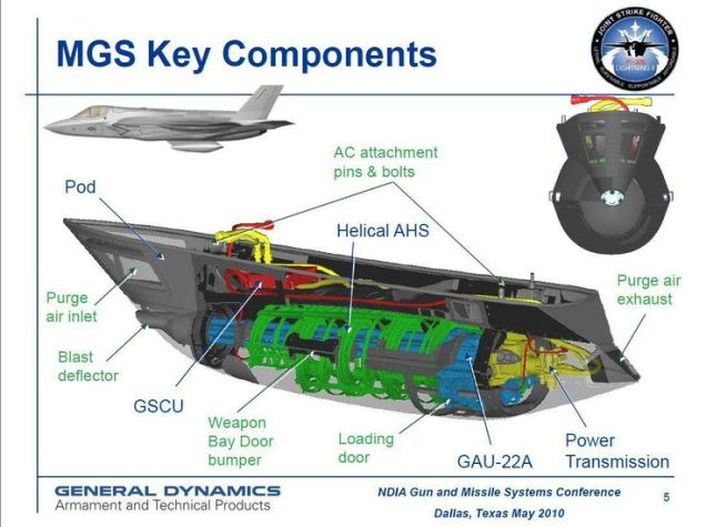
Italy is one of the three countries operating the Short Take-Off and Vertical Landing (STOVL) variant of the F-35 outside of the U.S., with the others being the UK and Japan. While the UK has confirmed that it has no plans to acquire or integrate the 25 mm gun pod on its F-35Bs, there is no information regarding the Japanese aircraft.
The GPU-9/A gun podContrary to the F-35A variant, the F-35B and F-35C don’t have the internal GAU-22/A 25mm cannon, and are thus forced to employ an externally mounted gun pod. The gun pod, technically known as the Gun Pod Unit (GPU) – 9/A has always been quite controversial, as both the F-35B and F-35C have to rely on this external device that, despite the “stealthy” shape is believed to induce a Radar Cross Section (RCS) degradation. It is worth noting that the variant used by the F-35C, although apparently similar, is designated as GPU-8/A.
Another controversy is related to the ammo carried in the pod, 220 rounds, which is less than the ammo carried by the aircraft replaced by the F-35 (300 rounds on the Harrier, 412 on the Hornet and 578 on the Super Hornet). It should be noted that the F-35A carries even less ammo, just 180 rounds.
The pod has its share of trouble, with some notable incidents, like the Class C mishap when a PGU-32/U Semi-Armor Piercing High Explosive Incendiary-Tracer (SAPHEI-T) 25mm round exploded after leaving the gun pod during a night CAS (Close Air Support) mission over the Yuma Range Complex.
A U.S. Marine Corps F-35B with the centerline gun pod clearly visible under the fuselage. | Source: U.S. Marine Corps photo by 1st Lt. Zachary Bodner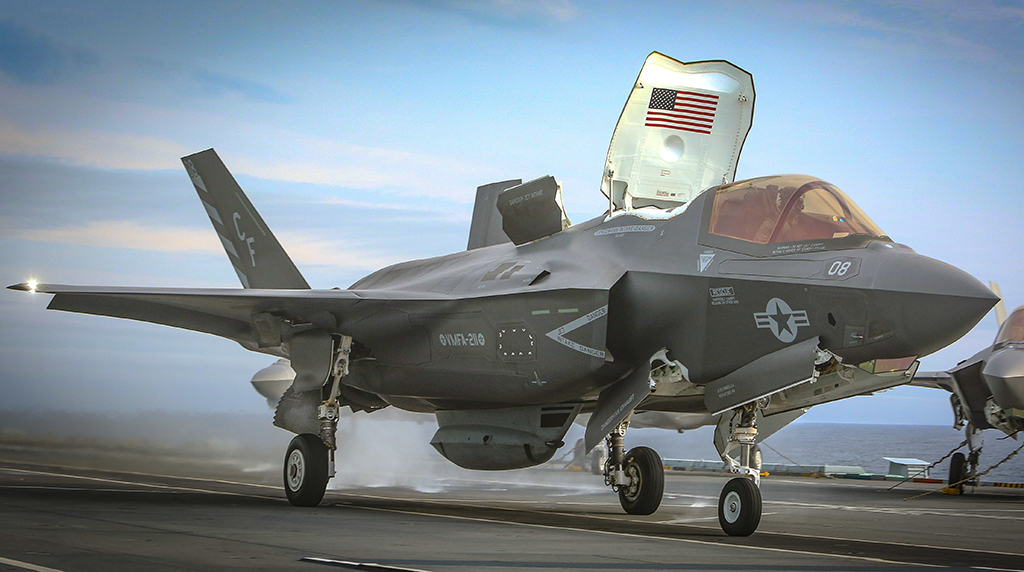
In July 2021, an USMC F-35B, which was deployed on the HMS Queen Elizabeth aircraft carrier in the Pacific Ocean, was forced to divert and land at Kadena Air Base because of unspecified issues with the gun pod, with the aircraft taxing to a remote area and with firefighters on standby as maintainers troubleshoot the problem.
The GAU-22 is reported to be more than 40 pounds lighter and requires 20 percent less overall space than the earlier GAU-12 5-barrel 25mm gun. The new GAU-22 weapon has a reported rate of fire of “up to 3,300 rounds per minute.”
One final point regarding the pod and its potential use by the Italian Air Force: it is not yet clear whether the F-35’s gun will be employed in both the air-to-ground and air-to-air roles, although the service may also be interested in exploring its use for counter-UAS missions.
At present, Italian F-35s, both the A and B variants, can only carry the AIM-120 AMRAAM (Advanced Medium Range Air-to-Air Missile) for air-to-air engagements. Italian F-35s have already supported both domestic and NATO QRA (Quick Reaction Alert) missions, and while they are expected to receive the AIM-9X Sidewinder in the future, using an advanced and relatively expensive air-to-air missile against a low-cost drone, such as those recently engaged by Italian Eurofighter Typhoons in the Baltic region, would not be a cost-effective solution in the long term. While using an F-35 to engage a Russian drone with the gun pod would still be a sub-optimal solution, it would nevertheless be preferable to expending an expensive air-to-air missile.
This means the Italian Air Force could be interested in using the gun pod not only against ground targets in a traditional CAS (Close Air Support) role, but also for counter-UAS missions, hence the need to test it in the Sardinian ranges.
Thanks again to Diego Mor for the photo he sent us. Make sure to follow him on Instagram for more!
Categories: Defence`s Feeds
Les enjeux des élections brésiliennes
Le 4 octobre, les Brésiliens redéfiniront leur paysage politique lors d’élections générales. Dans ce contexte, 13 candidats s’opposeront pour la présidentielle.
Ce scrutin attire tous les regards. Deux enjeux majeurs le caractérisent : une forte polarisation entre la gauche de Luiz Inácio Lula da Silva et l’extrême droite de Flávio Bolsonaro ; une ingérence de Washington dans la campagne.
Une victoire de Flávio Bolsonaro, soutenu par l’administration Trump, pourrait ainsi faire basculer toute la région du côté des projets du président américain visant à repositionner l’Amérique latine comme zone d’influence des États-Unis.
Quels sont les véritables enjeux de ces élections ? Alors que la polarisation domine la vie politique nationale, l’influence de Washington pose une question cruciale : jusqu’où l’ingérence américaine peut-elle aller ? Nouvelle chronique de l’Amérique latine avec Christophe Ventura, directeur de recherche à l’IRIS et responsable du Programme Amérique latine/Caraïbe.
L’article Les enjeux des élections brésiliennes est apparu en premier sur IRIS.
Categories: Diplomacy & Defense Think Tank News
Can Kashmir Learn From India’s Gen Z Movement?
J&K has lost its statehood, local governance, and even the right to protest. But there is still a way to resist.
Why Are Modi Government Critics Now Targeting India’s Chief Election Commissioner Gyanesh Kumar?
A recent investigative report strengthens opposition charges that the Modi government is using Kumar to manipulate elections in favor of the BJP.
Categories: Diplomacy & Crisis News
China’s Stake in the Russian Duma Elections
The topic is a controversial one in China due to the obvious parallels between the Russian and Chinese political systems and the stake the Chinese leadership has in the stability of their neighbor.
Categories: Diplomacy & Crisis News
Afghanistan’s Drought Deepens, and Women Bear the Heaviest Burden
As wells and other water sources dry up, women and girls in Kabul must travel increasingly long distances to secure enough water for their families. Credit: Learning Together.
By External Source
KABUL, Oct 1 2026 (IPS)
Drought has depleted wells, withered fruit trees, and reduced crop yields across Afghanistan. The heaviest burden of the water shortage falls on women in their daily lives, as they must fetch water from increasingly distant sources and use every single drop with extreme care.
More than half of Afghanistan is suffering from a prolonged drought and water shortage. The situation is critical in 19 provinces. Authorities predict the crisis will worsen. For instance, the capital, Kabul, is projected to lose the majority of its groundwater by 2030. In the northern province of Faryab, 90 percent of the area is already affected by drought.
Drought affects every aspect of her life. She struggles daily to secure enough water for her family’s needs. As an orchardist, she watches helplessly as the trees she has tended for years slowly wither and die while still standing
Water scarcity and poor harvests are further exacerbating Afghanistan’s food crisis. According to the UN World Food Programme, as many as 17.4 million people are in urgent need of food assistance.
Wells, springs, and groundwater sources are drying up. In some households, the water level in wells has dropped from 20 meters to 40 meters. On farmlands, water must now be drawn from depths of up to 120 meters, whereas previously it was accessible at 20 meters. Water is being rationed, and in some areas, farmers receive water for only 20 minutes a day.
When Afghanistan’s wells run dry, women’s workload increasesIn Logar province, near Kabul, drought and water shortages have damaged crops and caused fruit trees to wither. Women must walk increasingly long distances to fetch water for their families.
“When our well ran dry, my immediate concern was whether there would be enough drinking water for our children. I only wash clothes if there is drinking water left over. Sometimes I go several days without doing laundry. I also gather the dishes from three meals and wash them all at once to save water,” says 35-year-old Simin Gul (name changed).
The well belonging to her family of nine ran dry four years ago. The nearest water source is less than a half an hour’s walk away.
At times, Simin Gul and her neighbors are forced to buy water. The local piped water network supplies water only two days a week, and even then, only for a few hours at a time.
Families help one another and take turns collecting water in large containers, but even that is not enough for large families.
The wells around Simin Gul’s home have dried up one by one. Women suffer from back pain and other ailments from carrying heavy water containers from distant sources.
Fetching water is particularly difficult during menstruation. Women must fetch water even when they need rest. At times, children have to miss school to help their mothers carry water.
Water scarcity and poor water quality also cause hygiene and health problems for families.
“The tanker trucks have plastic tanks, and the trucks travel from street to street under the scorching sun. Our children have fallen ill from this water several times,” says Simin Gul.
Drought-damaged crops in Logar province, near Kabul, where water shortages have reduced harvests and caused fruit trees to wither. Credit: Learning Together.
Drought deepens water inequality: “The wealthy can dig deeper wells”Water scarcity has also changed the daily life of 50-year-old Zarmina (name changed). She has lived and worked on her orchard for about 20 years. Her husband is also a farmer.
“This year, about 50 of my apple and apricot trees dried up. I’ve managed to keep the remaining hundred trees barely alive thanks to a spring. But both the yields and the fruit are smaller and of poorer quality.”
“Some farmers pay for irrigation, but we can’t afford it. My husband lost his tomato crop this year because tomatoes need a lot of water,” Zarmina laments.
Zarmina’s husband farms an area of about 60 acres. This year, he planted only half of it because of the water shortage.
“The wealthy can have deep wells dug. The fields of the poor remain dry,” Zarmina notes.
However, according to her, the problem is not just a lack of water but also inadequate infrastructure.
“Some areas have a piped water system. We should have one too, and the government ought to repair the irrigation canals as well. The problem is that Afghanistan has water, but it isn’t distributed efficiently,” she continues.
Zarmina is sometimes forced to buy drinking water, as her own well has very little water, and what remains is salty. Unless the authorities do something about the water shortage, the result will be a disaster, Zarmina believes.
Drought affects every aspect of her life. She struggles daily to secure enough water for her family’s needs. As an orchardist, she watches helplessly as the trees she has tended for years slowly wither and die while still standing. Together with her husband, she mourns the loss of productivity in their fields, where crop yields have dwindled because of the drought.
For Zarmina, water scarcity means more than just the drying up of springs; it means jeopardizing an entire livelihood and way of life, as well as constant worry about her children’s access to water.
As drought worsens, life in Kabul revolves around waterWater scarcity affects the capital, Kabul, too, even just a stone’s throw from the former presidential palace.
Sixty-year-old Shazia (name changed) lives in western Kabul. A large part of her week is spent securing water for her family of five.
To meet their daily needs, families either buy water or wait for the local communal tap to start running. Water used to flow every few days, but now the wait can be much longer.
When the water finally arrives, large containers and buckets are filled, and as much as possible is stored.
“Our lives revolve around water. We buy different types of water for different needs: bottled water for tea, filtered water for cooking, and tap water for washing and the toilet,” Shazia says.
Sheila lives on one of the hills in western Kabul. Together with her young daughter, she tries to find enough drinking water for her six children.
In Sheila’s neighborhood, some homes are connected to a private water supply system that delivers water every two days. Those who cannot afford it buy their water. Another option is to carry water uphill to their homes in heavy containers.
Before water flows properly from the taps of households connected to the private system, it must be allowed to run from the main street pipe for a few minutes. When nearby residents see the water flowing, they rush to the spot with their jerry cans.
“If we’re lucky, we manage to fill a few containers. Here, next to the presidential palace, we aren’t looking for a gushing water source anymore. A few drops for our children are enough for us,” Sheila laments.
“Aid organizations used to install water pipes, but no one comes to help anymore. We’ve been left here with empty jerry cans and thirsty children.”
Excerpt:
The author is an Afghanistan-based female journalist, trained with Finnish support before the Taliban take-over. Her identity is withheld for security reasons
Categories: Africa
As University of Tokyo Gets Its First Female President, How Far Is Japan From Gender Equality?
Fujigaki Yuko’s selection sparked controversy – and shone a light on Japan’s stubborn gender gap.
Pages


© 2012-2018 Europa Varietas Foundation © 2015-2018 Europa Varietas Association
www.europavarietas.org | info(@)europavarietas(dot)org | Switzerland


We are looking for sponsors for the English translation of these books, please contact turkeandras(at)gmail(dot)com